
For Humans, Grounded in Tradition and Science
Rest,Restored.
Sleep is not something you can switch on. It is a process your body prepares for over the evening, and the habits around it matter as much as anything you drink. This page explains how that process works, what research says about the herbs traditionally used to support it, and exactly what goes into Relaxie.
A calmer evening, one cup at a time.
Sleep 101
How your body moves from awake to asleep, what research says about the herbs traditionally used to ease that transition, and what's really inside Relaxie.
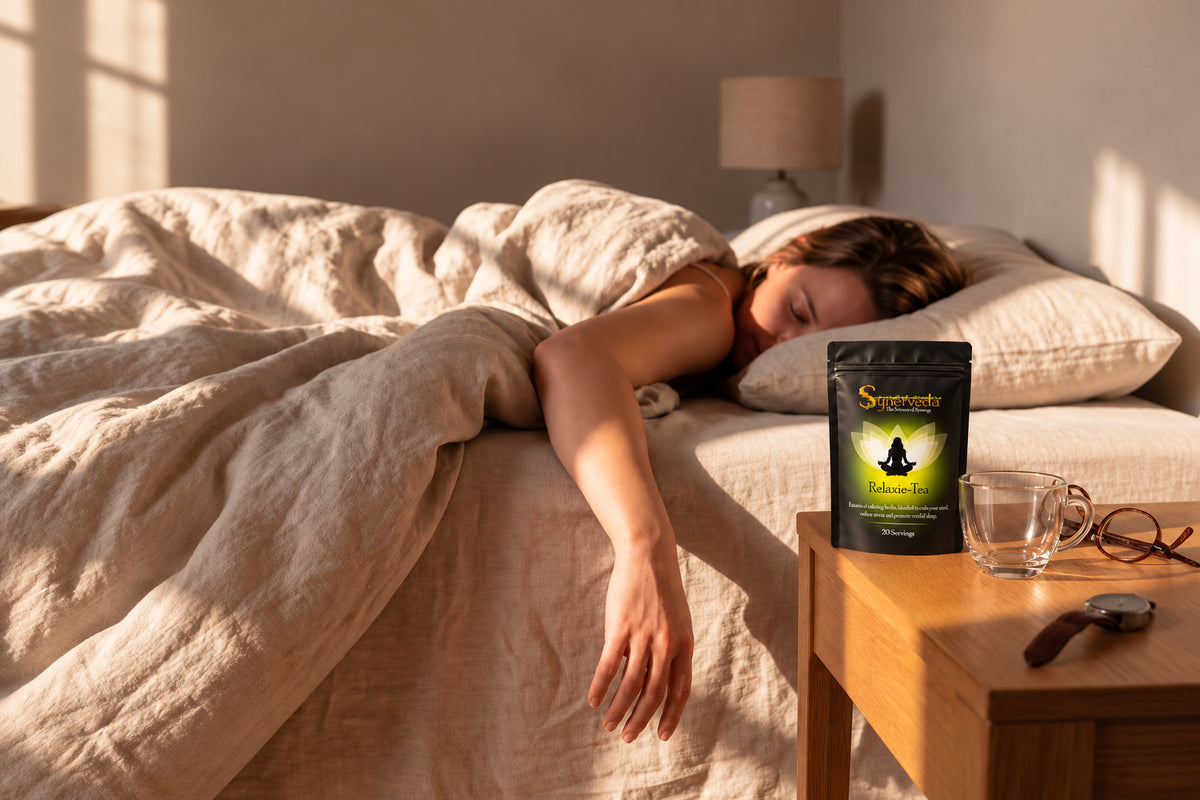
"What can I drink to sleep better?" is one of the questions we hear most — often from people who have already tried cutting caffeine, putting the phone away, and going to bed earlier.
It's worth answering carefully, because sleep is an area full of big promises. This page covers how sleep is regulated in the body, what's known — and not known — about the herbs traditionally brewed before bed, and exactly what's inside Relaxie and why.
We're not going to tell you a tea will cure insomnia. We're going to tell you what the research shows, where it's thin, and let you decide for yourself.
Key Terms
Definitions
Terms you'll run into on this page and across our ingredient research.
Concentrated Extract: A processed form of a herb where its compounds have been isolated and densified, so a given weight contains more of the active compound than the same weight of raw, dried herb.
Traditional Use: Historical use of a herb within a documented medical tradition (Ayurveda, Traditional Chinese Medicine, European herbalism, etc.), distinct from — and not a substitute for — modern clinical evidence.
Studied Compound: A specific chemical identified within a herb and examined in research, rather than the whole plant.
Sleep Latency: The time it takes to fall asleep after getting into bed — one of the most common outcomes measured in sleep studies.
Melatonin: A hormone released by the brain as light fades, signalling to the body that night has arrived. It times sleep rather than forcing it.
How Sleep Actually Works
Sleep is regulated by two systems working together. The first is sleep pressure: the longer you are awake, the more a compound called adenosine builds up in the brain, and the stronger the urge to sleep becomes. The second is your circadian rhythm, an internal clock set mainly by light, which tells the body when night is coming through the release of melatonin.
When those two signals line up, falling asleep tends to be easy. Trouble usually starts when something keeps the body alert after the signals say it is time to rest — stress, a late screen, caffeine still in the system, or an irregular schedule.
None of this is specific to Synerveda — it's standard, well-established sleep science. It matters here because any herb that claims to help with sleep is working against this backdrop, not replacing it.
How Functional Herbs Work
Herbal teas don't override the body's sleep systems. What research looks at is more modest: whether certain plant compounds interact with the calming pathways that help the body settle, particularly the GABA system, which quiets nerve activity.
-
Extraction — A herb's compounds are released into hot water as the tea steeps, or concentrated beforehand into an extract.
-
Absorption — Once you drink it, these compounds are absorbed through digestion like any other food or drink compound.
-
Interaction — Some of them — such as compounds in valerian root and chamomile's apigenin — have been studied for interaction with GABA receptors, which play a role in the body's calming pathways.
We want to be precise about the word "studied." Studied doesn't mean guaranteed. It means researchers have looked at a specific mechanism and found a plausible, sometimes well-replicated, sometimes inconsistent, relationship — not a proven, universal effect in every person who drinks a cup.
What's Inside Relaxie — and Why
Relaxie combines six botanicals traditionally brewed in the evening. Each has its own tradition and research record, and they are not all equally well studied.
Valerian Root
An aromatic root used in European herbalism for sleep since antiquity. The most researched herb in this blend for sleep, though reviewers describe the results as promising but inconsistent across trials.
Chamomile
A gentle flowering herb brewed as an evening ritual across many traditions. Studied compound: apigenin, examined for GABA-A receptor interaction. Human sleep trials are small but encouraging.
Lavender
Best known as a scent. Most of its human research uses a concentrated oral lavender oil preparation for anxiety, which is a different form from a tea.
Lemon Balm
A lemon-scented member of the mint family, traditionally infused for calm. Small human studies have looked at it for mild anxiety and sleep disturbance.
Sarpagandha
An Ayurvedic root (Rauvolfia serpentina) traditionally used in calming preparations. It is the natural source of reserpine, a compound once prescribed for high blood pressure.
Fennel Seeds
Included mainly for digestive comfort and to balance the stronger, earthier herbs. We are not claiming a sleep effect for fennel.
Sarpagandha is the most potent herb in this blend, and we want to be clear about it. It contains reserpine, a compound with real effects on blood pressure and mood. If you have low blood pressure, a history of depression, or take blood-pressure or psychiatric medication, please talk to your doctor before drinking Relaxie.
Choosing a Quality Herbal Tea
Not all herbal tea on a shelf is built the same way. A few things worth checking before you buy any herbal blend — ours included:
Species and Plant Part
"Valerian" usually means the root of Valeriana officinalis, which is where its studied compounds are concentrated. Teas that use leaf, other species, or vague "valerian blend" labels may not give you the same thing.
Concentration, Not Just Presence
A herb listed on a label tells you it's present. It doesn't tell you how much, or in what form — whole dried leaf and a 10:1 extract are not the same product, even with an identical ingredient list.
Disclosed vs. Proprietary Blends
A "proprietary blend" on a label legally allows a brand to hide individual quantities. We don't use this — every botanical's relative share of the formula is something we're willing to show.
Traditional Use vs. Clinical Study
Both are worth knowing, but they're not the same kind of evidence. A herb with centuries of traditional use and a herb with a randomized clinical trial behind it are making different kinds of claims on your trust — a careful brand (and a careful reader) keeps that distinction clear.
Q&A
How long before bed should I drink it?
There's no clinical timing for Relaxie as a finished product. Many people drink it 30 to 60 minutes before bed as part of a wind-down routine, which is useful in itself: a regular, screen-free ritual is one of the habits most consistently linked with better sleep.
Will I feel groggy in the morning?
Valerian studies generally report few morning-after effects compared with prescription sleep aids, but people respond differently. Try it on a night when you don't need to be up early, and see how you feel.
Can I take it with sleeping pills or other medication?
Please check with your doctor first. Valerian may add to the effect of sedatives, and sarpagandha can interact with blood-pressure and psychiatric medication.
Has Relaxie itself been clinically tested?
Not yet, and we'd rather say that plainly than let ingredient research imply otherwise. Everything on this page describes research on the individual herbs. We'll update this page if that changes.
Further Reading
Citations
- Borbély, A. A. (1982). A two process model of sleep regulation. Human Neurobiology.
- Bent, S., et al. (2006). Valerian for sleep: a systematic review and meta-analysis. American Journal of Medicine.
- Fernández-San-Martín, M. I., et al. (2010). Effectiveness of valerian on insomnia: a meta-analysis of randomized placebo-controlled trials. Sleep Medicine.
- Zick, S. M., et al. (2011). Preliminary examination of the efficacy and safety of a standardized chamomile extract for chronic primary insomnia: a randomized placebo-controlled pilot study. BMC Complementary and Alternative Medicine.
- Hieu, T. H., et al. (2019). Therapeutic efficacy and safety of chamomile for state anxiety, generalized anxiety disorder, insomnia, and sleep quality: a systematic review and meta-analysis of randomized trials and quasi-randomized trials. Phytotherapy Research.
- Kasper, S., et al. (2010). Silexan, an orally administered Lavandula oil preparation, is effective in the treatment of "subsyndromal" anxiety disorder: a randomized, double-blind, placebo controlled trial. International Clinical Psychopharmacology.
- Cases, J., et al. (2011). Pilot trial of Melissa officinalis L. leaf extract in the treatment of volunteers suffering from mild-to-moderate anxiety disorders and sleep disturbances. Mediterranean Journal of Nutrition and Metabolism.
- Lobay, D. (2015). Rauwolfia in the treatment of hypertension. Integrative Medicine: A Clinician's Journal.
- Badgujar, S. B., Patel, V. V., & Bandivdekar, A. H. (2014). Foeniculum vulgare Mill: a review of its botany, phytochemistry, pharmacology, contemporary application, and toxicology. BioMed Research International.
See the full Relaxie formula, how to brew it, and who it is (and isn't) for.
Shop Relaxie Tea →*This page discusses general physiology, published research, and traditional use associated with Relaxie Tea's botanical ingredients. It does not describe clinical research on Relaxie Tea as a finished product, and does not constitute a claim that this product diagnoses, treats, cures, or prevents any disease. Statements have not been evaluated by the FSSAI. Please consult a healthcare practitioner before use, particularly if pregnant, nursing, or on medication.